This week, I was able to draw from life again: this time with one of my friends, Elise. Knowing the person well adds an additional challenge to the proportion stage, as your eye can easily recognize when things are wrong. I found myself asking, “What makes her Elise?” What are the key characteristics about her face that are essential to get accurate to achieve her likeness. We often have a preconceived notion of what features generally look like, and tend to impose that in our drawings. I noticed myself making this mistake this week. The key is training your eye to catch exactly what is wrong about proportion, and to not just be stuck thinking, “something isn’t right about this.” I’ve noticed that drawing from life gives the drawing a looser feeling. However, with this feeling comes proportional mistakes that I don’t typically encounter when working from a photo. I’m trying to figure out exactly why this keeps happening.
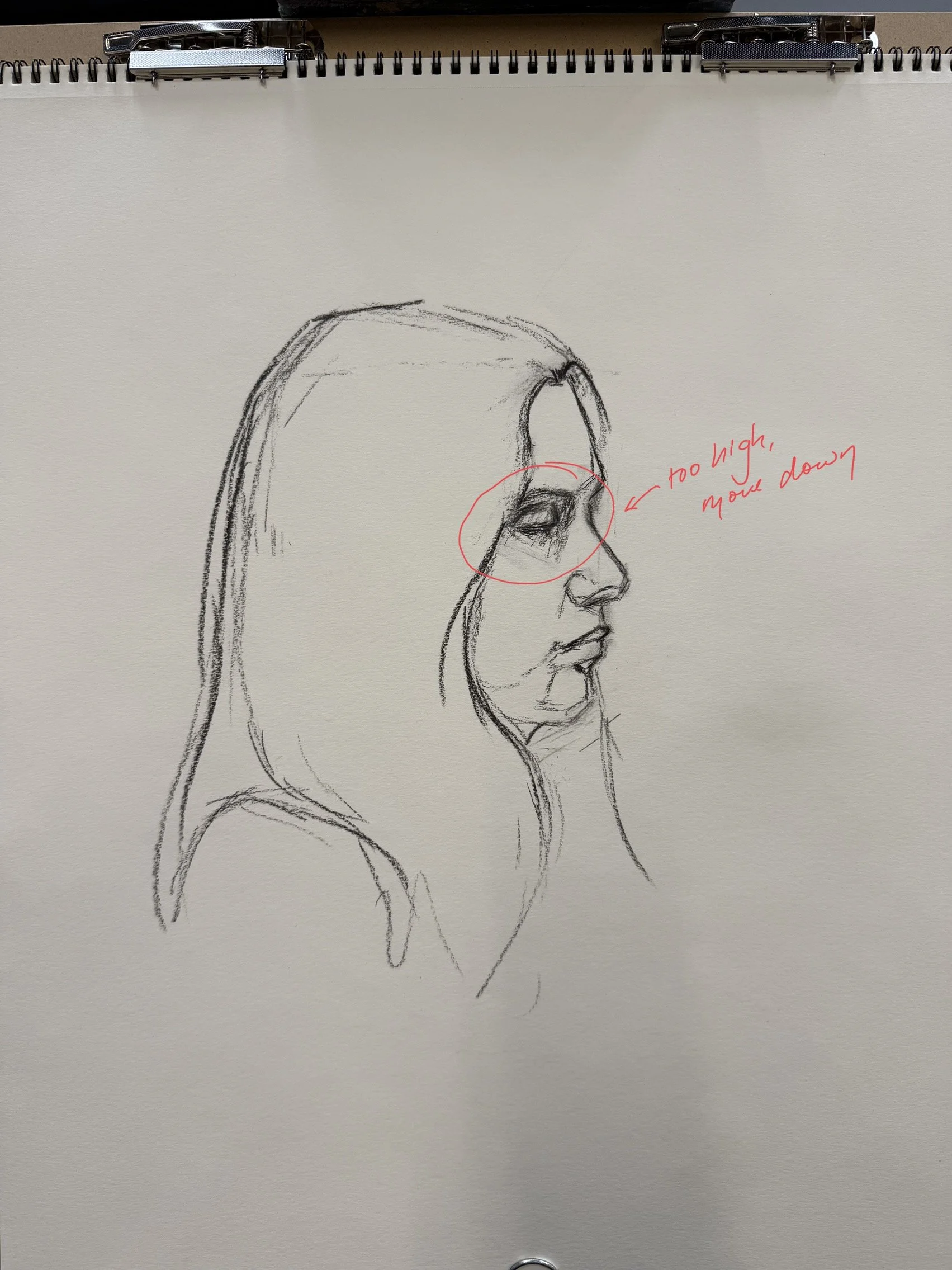
Initial Sketch
As I began this session, I used my small stick of vine charcoal to lay out her features. Admittedly, this stage calls up all the impostor syndrome thoughts to the forefront of my mind. The daunting task of a large blank sheet of paper in front of me, with my friend sitting not far behind, causes me to forget how much I’ve been trained to do this. Every decision I make at this stage is almost crisis management: I use vine charcoal because it can be easily erased and moved. I don’t fully commit to putting down compressed charcoal until far later in the block-in stage. This stems from my usual process, where painting is messier in this early stage. I backed up and noticed that I had placed the eye too high, so I lowered it in the next step.
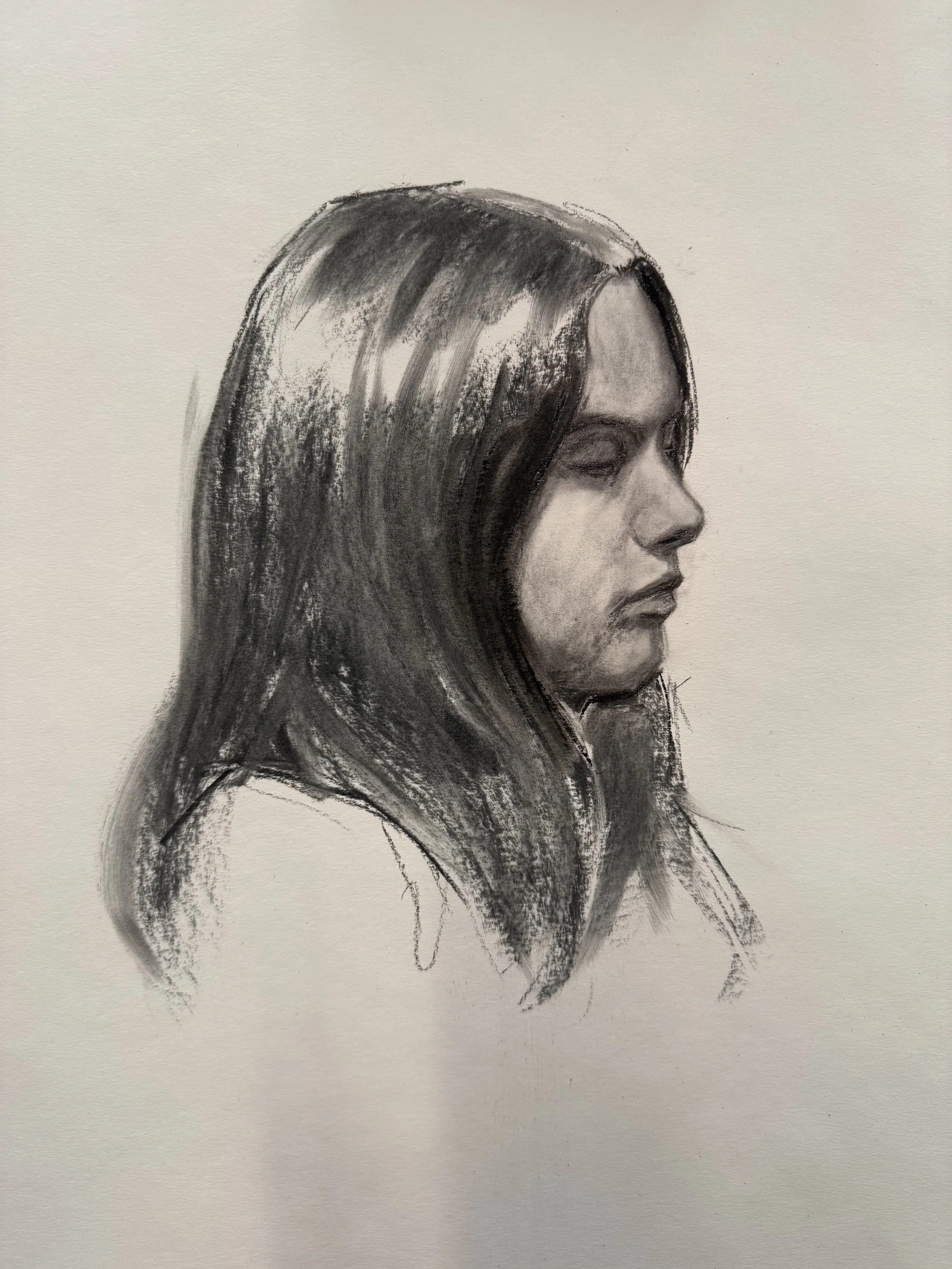
Value Block-in
My next step was to mass in the main value shapes, and to start moving the charcoal around to create midtones. Usually, after my value block-in, I need to adjust proportions a bit. Something about having the shadows blocked in opens my eyes to proportional mistakes. I have also been noticing that I usually go too light on the skin tone, leaving there no room for specular highlights. To prevent this, I made sure to get the darkest value into the drawing early, so I could set a reference point for my value range.
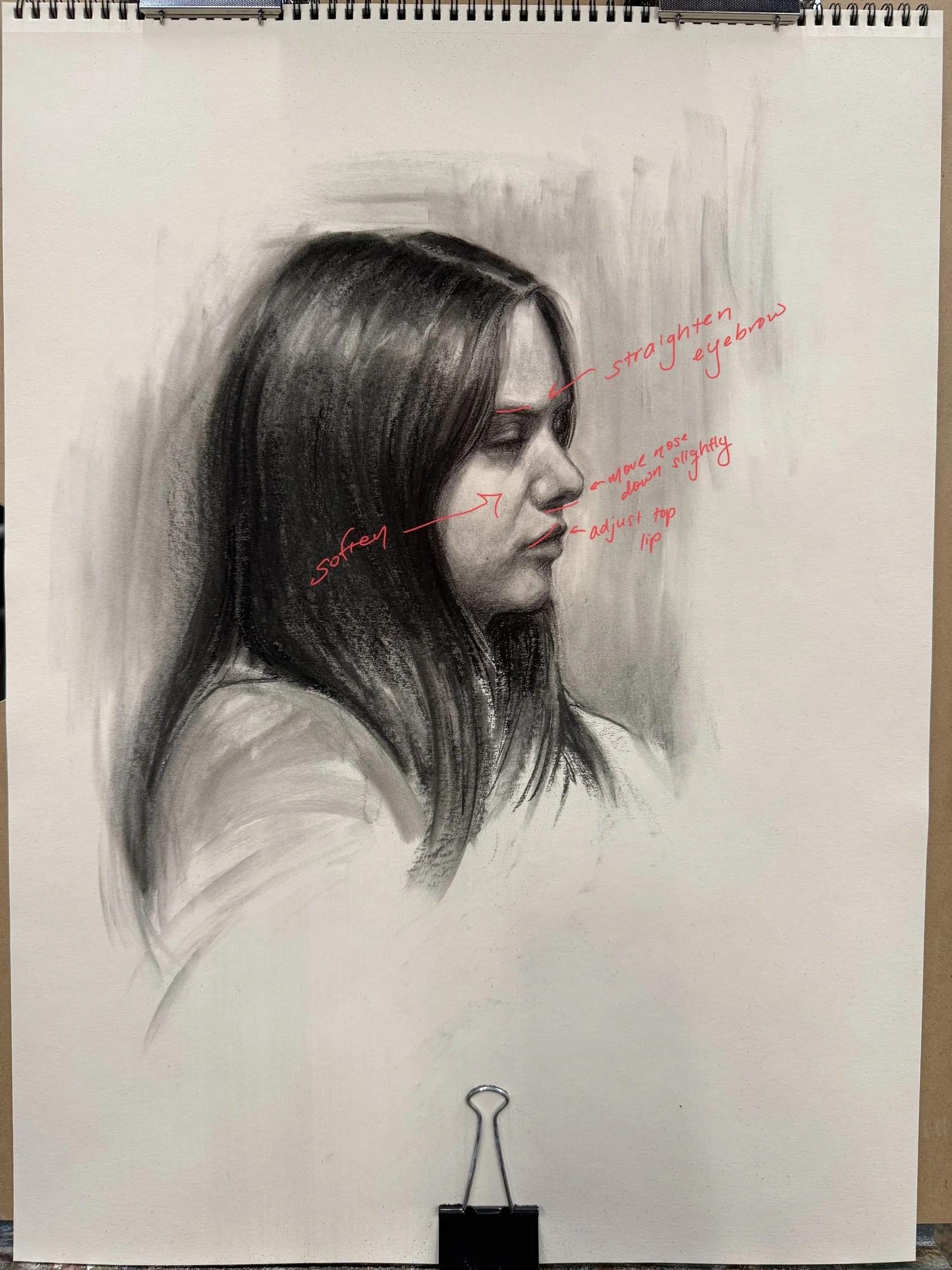
Drawing at the end of live model session (3 hours).
As I continued, I kept rendering key characteristics of the face. One of the trickiest areas to draw from life is the eyes – they’re constantly moving. You have to recognize this early on and commit to one position. I found myself continually adjusting the eyes as the drawing progressed - my drawing had opened and closed her eyes multiple times throughout the entire process.
I find that my tendency is to keep things very soft, leaving me to have to reestablish proportion several times. However, I do like to retain some softness in the eyes and lips, as this suggests movement. By the end of this session, I felt that it definitely was looking like her… but I just wasn’t satisfied with it. There was something missing that truly made her feel like herself. However, since we were out of time, I took a photo and worked on it back in my studio.
Once I was able to look at my drawing next to the photograph, I studied how it differed. Although it doesn’t matter much if it differs slightly from the photograph, as drawing from life should not look like a photograph. As long as the likeness is there, then it is a successful drawing. What was missing from mine? Why wasn’t this Elise?
As I looked closer at the features, there were a few that really are characteristic of her face: the curve of the upper lip, the small muscle at the corner of the mouth, the curve of the nostril, and the tilt of the eyebrow. I had unknowingly adjusted these features to a more generic version. These small adjustments took just a few minutes to achieve, but they completely transformed the drawing. It truly looks like my friend now. The goal is to recognize these small things in the moment, not in the studio afterward.
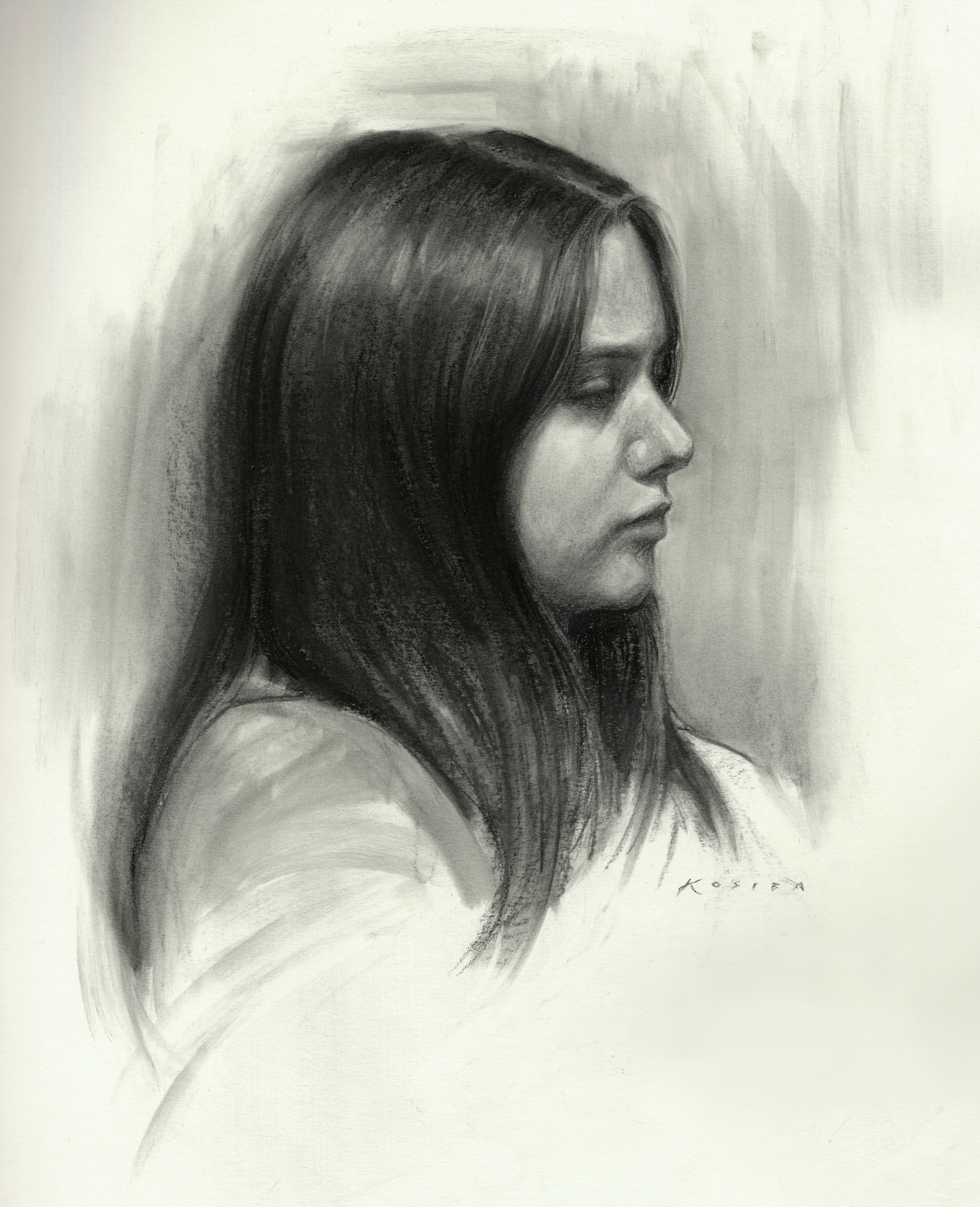
Drawing at the end of studio session (4 hours total drawing).
Something I continue to struggle with is the vignette around the image. I am constantly at a loss for how to make it an interesting and compelling composition as a whole. How much do I render things on the outskirts of the drawing? How much detail should I put into the clothing? I second-guess my decisions. I love the look of an unfinished drawing around the edges, but that requires a level of confidence I’m working to develop.
